Recently I observed something that as an early years practitioner was very familiar to me but I realise may be less familiar to some parents and even professionals: schemas.
What are schemas?
Schemas are repeated patterns of behaviour allowing young children, and those at early stages of learning, to construct knowledge and understanding of how the world works (England, 2018).
As a parent I have seen these throughout my children’s journey and still see them in their play. My son, who has a diagnosis of autism, has long been using positioning schemas in his play and will often line things up. The image below was taken whilst I was writing this blog!
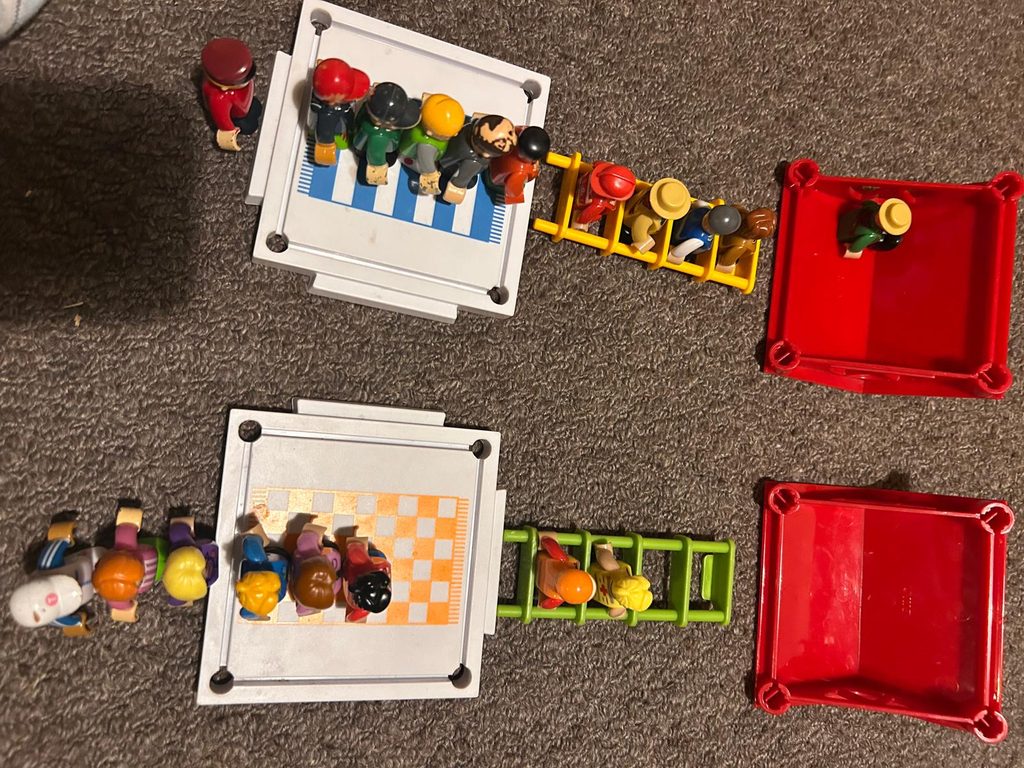
Schemas in action
When we recognise a child’s schema, we start to understand what is driving their play and what really matters to them at that moment. With my son and his positioning schema I asked him what he was doing. He said the toys were “waiting their turn”.
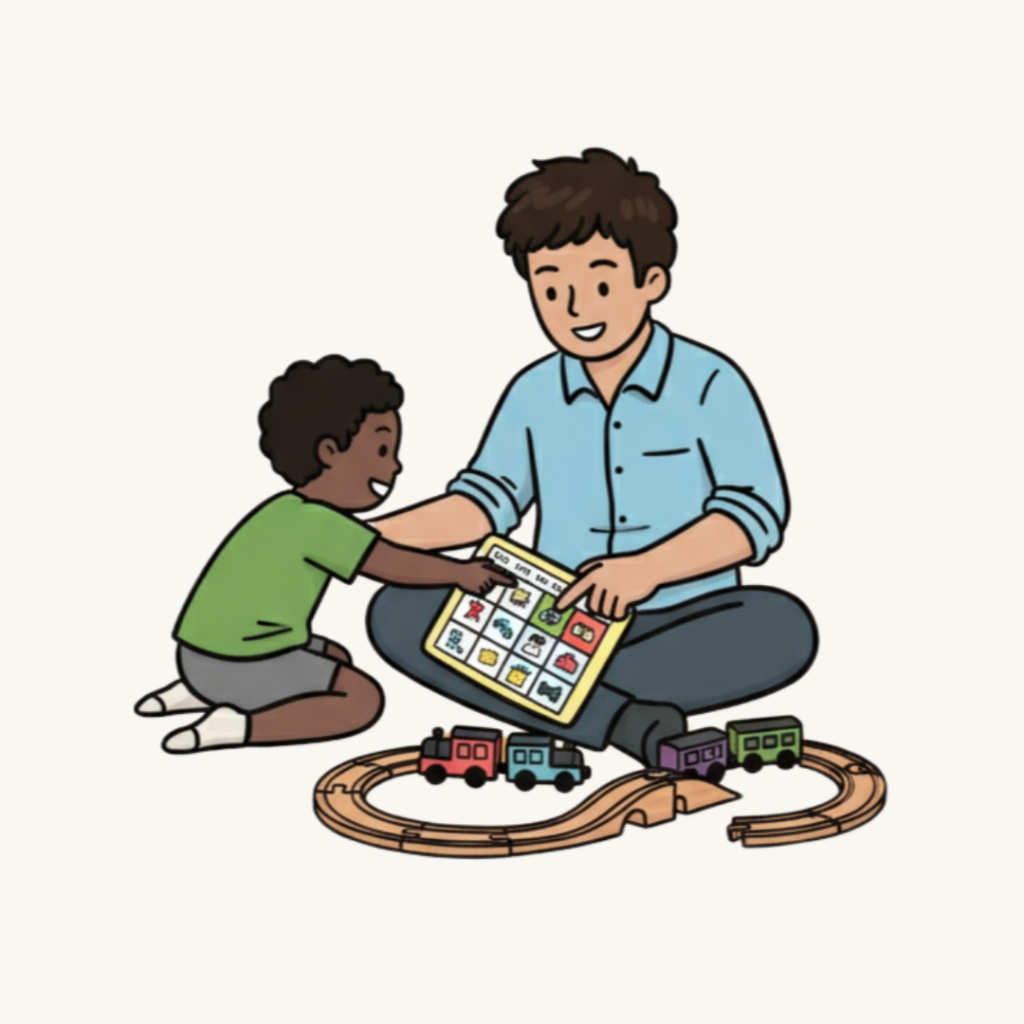
At a recent AAC stay and play session I noticed two children absorbed in certain schemas. One child was completely absorbed in wrapping a train in Play-Doh. Over and over I observed him covering it, pressing it down, taking it off then wrapping it again. This is what early years practitioners call an enveloping schema.
Another was lining things up and creating patterns, noticing the fine details of objects including shape, size and colour. This links closely with a positioning schema.
How I came to schemas
I first came across schemas during my teacher training. Someone mentioned them and handed me a book, I believe it was Stella Louis’s Understanding Schemas in Young Children, and reading it genuinely shaped my teaching. I began to see what children were really doing in their play, what they were focused on and what they enjoyed.
I was training in a special school, where many children were at the stage of early schematic play. The school was deeply engaged with schemas and used them as part of everyday practice.
From early years to AAC
Yet schemas remain very much an early years idea. In my experience, they are rarely talked about and they are almost absent from conversations about AAC and assistive technology. Even early years documentation such as Development Matters 2023 and the EYFS Statutory Framework 2026 do not mention them, instead using the language of ‘patterns’ within the areas of music and maths.
Schemas and core words
For me schemas pull out lots of language to support AAC users. Words such as again, more, different, in, on, stop. Core words which can be modelled across activities and environments.
It is tempting as a teacher to try and extend this language by planning to model colours, shapes or noun which label the objects of focus. But by choosing such words, are we reflecting the adult’s agenda? Don’t get me wrong, extending that vocabulary is great. But in this moment, when I want to be as present in the play as this child, I choose core.
Instead, with a core word approach, with words that actually carry the child’s own intent with what they are doing, we can empower children with words they can actually use to direct and talk about their play.
Each schema naturally pulls out certain core words. Enveloping invites in, cover, open and gone. Positioning invites there, next, on and same. When I spoke to my son I heard words like turn, stop, wait, go, you. When we know the schema, and join in the play first, the words start to suggest themselves.
For more information on core words see Project Core.
A neuro-affirming approach
After observing these children engaged in schemas I reflected on my own practice of modelling.
Schemas are child-led, person-led and natural parts of a child’s development. By supporting schemas, rather than trying to ‘move children on’, we are accepting where children are at. By focusing on observing, understanding and accommodating schemas, we are embodying a neuro-affirming approach to learning.
A neuro-affirming approach means respecting that focus rather than competing with it. We join the child in their world instead of pulling them into ours. It also means choosing language based on what interests the child, not on what we want to teach. For me, trying to model lots of vocabulary alongside a child so engrossed in schemas too early risks stopping the learning which is already going on.
So when do I model?
Something I try to do in my practice is join in with the play. It may sound simple, but for me I want to understand the motivation, language, actions and thought processes through what this child is experiencing.
I would suggest waiting for acceptance first and stop going in with your own agenda.
For me supporting play this way works a lot like Intensive Interaction. I play alongside the child, often mirroring what they are doing. Sometimes just playing alongside another child is a big step. There is a sense of shared attention and a quiet reassurance that my being there is okay.
What I am looking for is the sign that I have been accepted, that I haven’t taken the child away from their focus, but have perhaps added something small to their play. After that acceptance I might then think about modelling. Even then, I would keep it focused on single words, built into the natural pauses, linked to what they are doing.
Plan for play first
If there is one message I would love teachers, speech and language therapists, OTs and anyone supporting AAC users to take away, it would be to plan for play.
Plan for the child’s interests and see if you notice any schemas. Ask what these schemas are going to draw out of this child. Plan for engagement, and wait for acceptance.
The words and the language will come. Once you have that connection, that is when you can really bring in communication, and it will mean so much more to the child because it is about what matters to them.
Tom McDonald, AAC and Me
England, L. (2018) Schemas: A Practical Handbook. London: Bloomsbury (Featherstone).