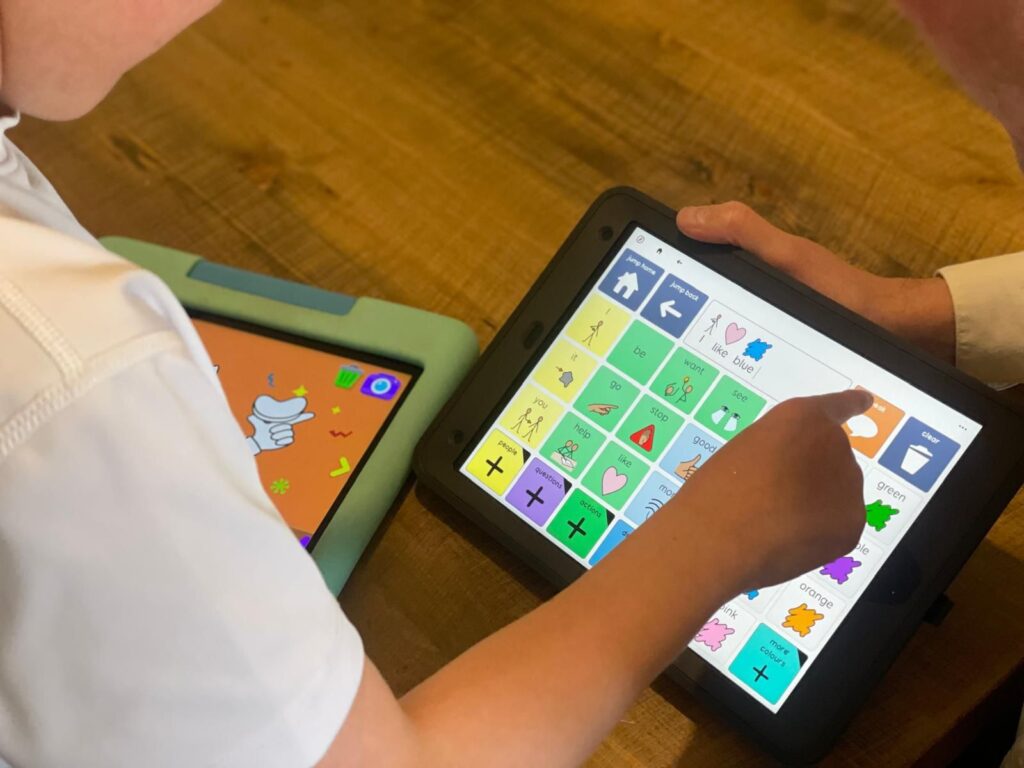
Over the past few months, I have been developing my understanding of Language Acquisition Through Motor Planning (LAMP). In November, I attended a LAMP workshop in Leeds, followed by Moving Forward with LAMP on iOS in December. More recently, I have been loaning an Accent 1400 to explore LAMP using an alternative access method, eye gaze.
This combination of formal training and hands-on exploration has been valuable, particularly in helping me reflect on how LAMP fits within my own teaching-led approach to AAC.
What is LAMP?
LAMP is an approach to AAC that focuses on how people learn language through movement, repetition and meaningful interaction. It is built around a few key ideas:
- Readiness to learn
- Joint engagement
- A unique and consistent motor plan paired with an auditory signal
- Natural consequences
One of the most important messages from the training was that there are no prerequisites for using AAC or for starting LAMP. A child does not need to show certain skills before beginning. LAMP can start right at the cause-and-effect stage.
Readiness to Learn: It Is Not About Waiting
When LAMP talks about “readiness to learn”, it does not mean waiting until a child can do more. Instead, it refers to whether the conditions are right in that moment.
If we briefly link this to Maslow’s hierarchy of needs, it reminds us that basic needs must be met before learning can happen. The environment matters, the timing matters and the task itself matters.
Put simply, learning is more likely to happen when basic needs are met. This might include:
- Being calm and settled
- Being in a low-stress, uncluttered environment
- Having had food, drink or the toilet
- Not being completely exhausted after a long day
If those conditions are in place, then learning can happen. Every child is different, which is why parents and teachers are usually the best judges of when the time is right.
Joint Engagement Comes First
Joint engagement means sharing an activity, object or moment with another person. This is a foundation skill for communication.
If a child is not yet comfortable sharing space, attention or enjoyment with someone else, then AAC work may need to take a step back. Approaches such as Intensive Interaction can help build these early communication skills, focusing on connection, enjoyment and shared experiences.
Before expecting a child to use AAC meaningfully, it is important that communication itself feels positive and rewarding. Following the child’s interests and making activities enjoyable is key.
Motor Planning: Learning Through Movement
A core part of LAMP is that each word stays in the same place. This allows the user to learn where words are through repeated movement, rather than searching visually each time.
During the training, one of the developers of LAMP described an AAC device as the user’s instrument. That idea really resonated with me.
When people first look at LAMP, it can seem overwhelming. There are lots of buttons. But learning LAMP is like learning an instrument. You do not learn everything at once. You start small, practise regularly and slowly build confidence.
The aim is for communication to become automatic. Over time, the user is not thinking about where a word is, they are just using it. This is similar to typing a familiar password or driving a regular route without consciously thinking through each step.
Hearing the Words Matters
LAMP places importance on hearing the word spoken when it is selected. This links the movement of choosing the word with hearing it out loud.
You might hear the phrase “neurons that fire together wire together”. In simple terms, this just means that the more we practise something in a consistent way, the stronger those learning pathways become.
AAC devices are speech-generating devices, and hearing the words spoken is an important part of learning language.
Vocabulary and Natural Consequences
LAMP focuses on using single words that can be combined in different ways, rather than relying on lots of pre-set phrases. Core words such as go, more and stop are used across many activities and situations.
LAMP also talks about natural consequences. These can include:
- Hearing the word spoken
- Seeing something happen
- Getting a response from another person
Communication only really works when there is someone there to respond. Being a good communication partner means modelling language, responding enthusiastically and using words across different activities and environments.
Supporting the Adults Around the Child
One feature I particularly like in LAMP is Vocabulary Builder. This allows adults to temporarily reduce what appears on the screen while keeping words in their usual places.
This is helpful not just for the AAC user, but for parents and staff too. It allows everyone to focus on a small number of useful words and practise them often, without changing the layout or confusing motor patterns.
Exploring Eye Gaze on the Accent 1400
While using the Accent 1400 with eye gaze, I have been exploring features such as Button Boost. This increases the size of the button target while keeping it in the same position.
This can be particularly helpful for users who are still developing eye gaze skills, as it supports accuracy without losing consistency. It feels like a thoughtful feature that fits well with LAMP principles.
Conclusion: Linking Back to My Ethos
What stands out to me about LAMP is how well it fits with a teaching-led, person-centred approach to AAC. It values time, consistency, relationships and meaningful practice.
AAC is not about waiting until a child is “ready enough”. It is about creating the right conditions, building strong communication partnerships and giving children the opportunity to communicate in ways that work for them.
At AAC and Me, my focus is on practical, real-world AAC that supports families and schools to feel confident. That means starting where the child is, keeping things simple, and embedding communication into everyday life, play and learning.
If you would like to explore LAMP further, these resources are a good place to start: