Over the past few weeks, I have been spending a lot of time talking about values.
Through a social enterprise training programme with Community First Yorkshire and conversations with case managers, I have been reflecting on what truly sits underneath the work we do at AAC and Me. Not just what we offer, but how and why decisions are made.
For us, three principles guide every assessment, session and training we deliver: person-centred, teaching-led and family-powered. These are not labels or buzzwords. They are the anchor points we return to when things feel complex or unclear.
Why values matter in AAC
AAC abandonment remains high. Even conservative figures suggest that around 40% of AAC systems are abandoned. From my experience as a teacher and assistive technology specialist, this is rarely about the technology itself.
What I have seen, repeatedly, is a growing gap between what is technically possible and the skills, confidence and understanding available in everyday environments. Devices are introduced with good intentions, but without enough support for the people who need to use them day in, day out.
Family-powered, because families are the constant
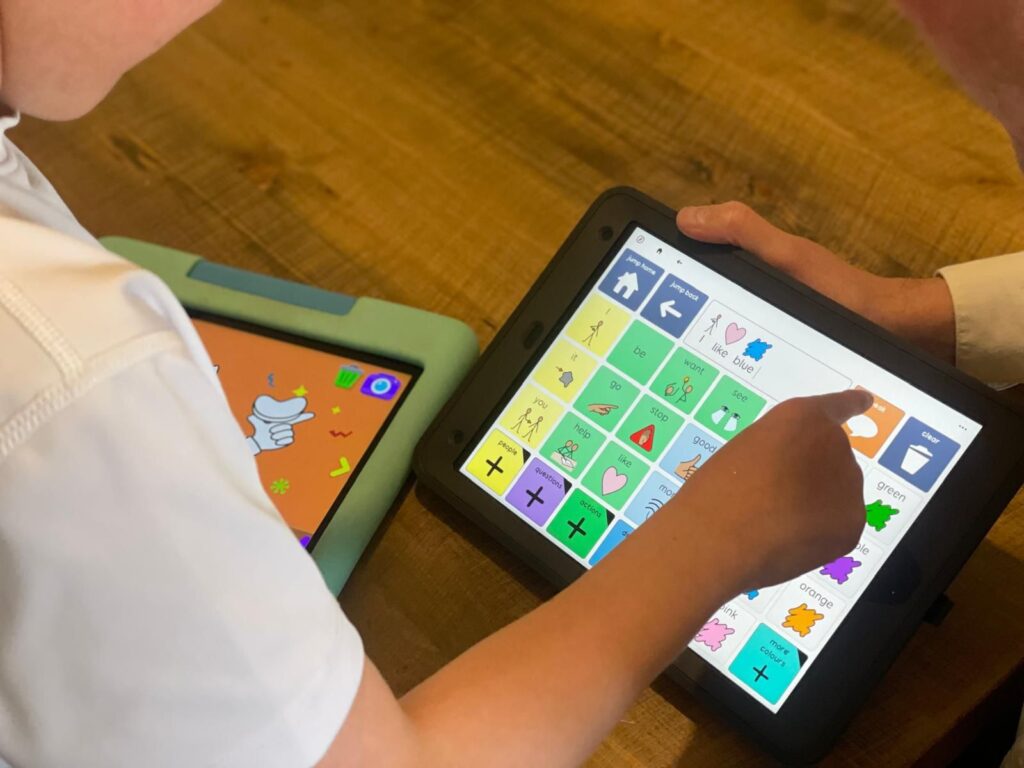
In December 2024, I started a club for AAC users. The original aim was simple: to create a space where AAC users could meet and practise using their devices with other AAC users. Very quickly, it became clear that families needed to be part of that space too.
Families are often the only constant in a child’s life. Schools change. Professionals move on. Services come and go. As a SEND parent myself, I know what it is like to navigate multiple professionals who may only be involved for short periods of time.
The most successful AAC journeys I have supported have always been those where families feel confident, informed and involved. Family-powered AAC means placing families at the centre of assessment and support, offering training that works around real life, and recognising that communication needs to function beyond formal settings.
Teaching-led, because AAC is a skill
AAC is not something that works simply because a device has been provided. It is a skill, and skills need to be taught.
Being teaching-led is not about my job title. It is about focusing on modelling, repetition and shared practice, for AAC users and for the people around them. Communication develops through seeing language used meaningfully across different people, places and contexts.
This approach goes beyond academic outcomes. It is about building confident communicators who can use language flexibly.
Person-centred, because motivation matters
AAC only works when it connects with the person using it.
Being person-centred means starting with engagement, interests and motivation. What does this child enjoy? What do they want to talk about? What captures their attention? These questions matter more than pre-set targets.
Play is central to this, even when it does not look like typical play. When my own child lines up cars or figures, the task is not to redirect him, but to understand what he finds meaningful and to model language within that activity. Children cannot be expected to use language they have not seen used in practice.
We model the language we want to hear. We create opportunities. We make communication feel worthwhile.
Returning to the values
At AAC and Me, these values shape decision-making every day. They influence how we assess, how we train, how we support families and how we measure success.
When things feel complex, we return to the same questions:
Is this person-centred?
Is this teaching-led?
Is this family-powered?
If the answer is no, we rethink the approach.
Because AAC works best when it is grounded in people, relationships and everyday life.